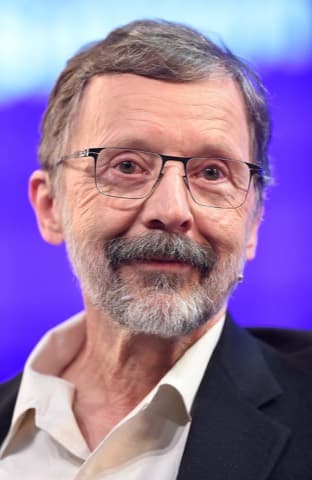
Ed Catmull Personality Type: INTJ
Co-founder and former President, Pixar Animation Studios; Walt Disney Animation Studios · The Strategic Architect
Ed Catmull, co-founder of Pixar, profiles as an INTJ with technical depth of 97/100 and creativity of 95/100. The most striking fact about him is documented and counter-intuitive: Catmull has aphantasia, an inability to form mental images. The person who co-founded the world’s leading computer animation studio, and who invented texture mapping and subdivision surfaces, cannot picture things in his own head.
Who is Ed Catmull?
Ed Catmull, born Edwin Catmull, is the American computer scientist who co-founded Pixar Animation Studios in 1986, later served as president of both Pixar and Walt Disney Animation Studios, and won the 2019 ACM Turing Award for pioneering work on computer-generated imagery.
He appeared on the David Senra podcast on June 14, 2026.
What makes Ed Catmull’s profile unusual?
Catmull is the strongest evidence in this index that creative leadership is not the same as personal creative vision. He has aphantasia and cannot form mental imagery, yet co-founded the studio that defined computer animation. His profile pairs very high creativity (95) with the highest people orientation of any founder here (88), which is consistent with what he actually built: not the images themselves, but the technical foundation and the organisational conditions under which other people could make them. He is also the only Turing Award laureate in this dataset.
Ed Catmull’s Big Five scores
| Openness | 95 | |
|---|---|---|
| Conscientiousness | 92 | |
| Extraversion | 42 | |
| Agreeableness | 62 | |
| Emotional Stability | 88 |
MBTI type INTJ is derived from these Big Five scores, not assigned separately. See the methodology.
Ed Catmull’s entrepreneurial traits
| Risk Tolerance | 72 | -10 vs median | |
|---|---|---|---|
| Visionary Thinking | 95 | +7 vs median | |
| Execution Focus | 88 | 0 vs median | |
| People Orientation | 88 | +23 vs median | |
| Technical Depth | 97 | +26 vs median | |
| Sales Ability | 58 | -27 vs median | |
| Resilience | 94 | +6 vs median | |
| Creativity | 95 | +11 vs median | |
| Analytical Rigor | 96 | +8 vs median | |
| Work Intensity | 85 | -4 vs median |
What is the evidence for these scores?
Every score above is an inference from the public record. The specific evidence behind each one is listed here so it can be checked.
Technical Depth
Highest technical depth in this index, established through foundational graphics research.
Earned a PhD in computer science from the University of Utah in 1974 with the thesis "A Subdivision Algorithm for Computer Display of Curved Surfaces", and developed texture mapping, bicubic patches, spatial anti-aliasing and subdivision surfaces, also independently discovering Z-buffering.
Wikipedia, "Ed Catmull" · 2026-08-17Creativity
Creative leadership without personal mental imagery.
“Catmull has aphantasia, an inability to form mental imagery.”
Wikipedia, "Ed Catmull" · 2026-08-17Resilience
Resilience across two decades before the work became commercially viable.
Became vice president of Lucasfilm’s new computer division in 1979 and co-founded Pixar in 1986 when Steve Jobs purchased that division, having created "A Computer Animated Hand" as early as 1972.
Wikipedia, "Ed Catmull" · 2026-08-17People Orientation
People orientation expressed as running multiple creative studios in parallel.
Appointed president of Walt Disney Animation Studios in 2007 alongside John Lasseter, supervising Pixar, Disney Animation and Disneytoon Studios as separate production pipelines until his retirement in July 2019, and co-authoring "Creativity, Inc." in 2014.
Wikipedia, "Ed Catmull" · 2026-08-17Analytical Rigor
Analytical rigor recognised at the highest level in computer science.
Received the ACM Turing Award in 2019, shared with Pat Hanrahan, "for pioneering work on computer-generated imagery", alongside Academy Scientific and Technical Awards in 1993, 1996 and 2001.
Wikipedia, "Ed Catmull" · 2026-08-17
Strengths
- Foundational technical invention: texture mapping, subdivision surfaces, spatial anti-aliasing and an independent discovery of Z-buffering
- Sustaining a research agenda across twenty years and three corporate owners before it paid off commercially
- Building organisational conditions for other people’s creativity rather than supplying it himself
- Running Pixar, Disney Animation and Disneytoon simultaneously while keeping their pipelines independent
Structural risks
- Low sales ability in a career that repeatedly depended on someone else funding the research
- Aphantasia means relying entirely on collaborators to evaluate the imagery being produced
- A culture built around one leader’s candour norms is difficult to transfer intact
- Deep technical identity can make organisational problems look like solvable engineering problems
Questions about Ed Catmull’s personality
What is Ed Catmull’s personality type?
On the Founder Mode framework, Ed Catmull profiles as INTJ, derived from a Big Five estimate of openness 95, conscientiousness 92, extraversion 42, agreeableness 62, emotional stability 88. His technical depth of 97 and analytical rigor of 96 are both at the top of this index.
Does Ed Catmull have aphantasia?
Yes. Catmull has aphantasia, an inability to form mental imagery. It is the most counter-intuitive fact in this index: the co-founder of the world’s leading computer animation studio cannot picture images in his own head, which suggests that building the conditions for visual creativity is a separate capability from having it personally.
What did Ed Catmull invent?
Foundational computer graphics techniques including texture mapping, bicubic patches, spatial anti-aliasing and subdivision surfaces, and he independently discovered Z-buffering. He received the 2019 ACM Turing Award, shared with Pat Hanrahan, for pioneering work on computer-generated imagery.
How do you compare to Ed Catmull?
The assessment scores you on the same 10 traits and the same Big Five scale used on this page, so your results are directly comparable.
Take the free assessment